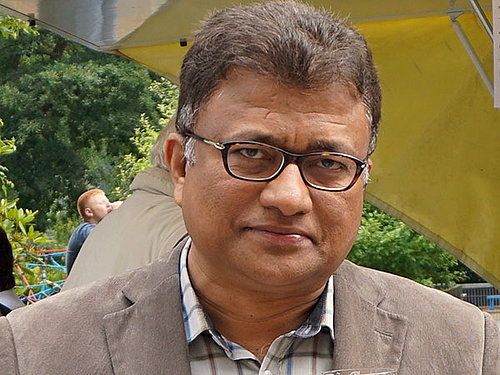
Science, and natural science in particular, does not emerge in a vacuum, but is characterised by cultural premises of knowledge. Who better to focus on these cornerstones of a European cultural grammar that establishes the primacy of the 'exact sciences' and thus the worldwide triumph of scientific research than someone who acquired early merits in civil engineering in his first years of study (B. Tech. 1988, University of Kerala). A resulting interest in spatial sciences and aesthetics led Babu Th aliath to study German (M. A. 1994, Jawaharlal Nehru University, New Delhi), which took him deep into the history of modern philosophy, its epistemological foundation in Kant's transcendentalism and Baumgarten's aesthetics, and into the current fields of research on the inseparable relationship between physical and mental experience.
Babu Thaliath, today a professor at the Jawaharlal Nehru University in New Delhi in the intersection of German studies and philosophy, completed his doctorate in philosophy from 1999 to 2002 under Professor Klaus Jacobi at the Albert-Ludwigs-Universität Freiburg as a KAAD scholarship holder on the subject of "Perspectivisation as a modality of symbolisation. Erwin Panofsky's undertaking to expand and specify the process of symbolisation in Ernst Cassirer's philosophy of symbolic forms" (Würzburg 2005). Professor Gottfried Boehm was a mentor, inspiring dialogue partner and teacher in the best sense of the word during this doctoral period, in the years that followed and to this day. In individual discussions and as part of the postgraduate colloquium at the Faculty of Art History at the University of Basel , Babu Thaliath was able to develop intellectually, but also to receive concrete support in his research projects.
Babu Thaliath 's years of teaching and travelling after his doctorate then took him to other well-known places in the philosophy of science in Europe: during a short research fellowship in 2007 - again via the KAAD - Professor Dominik Perler, Chair of Theoretical Philosophy at Humboldt-Universität zu Berlin, proved to be a mentor and would continue to help shape Babu Thaliath's life in the years to come. Shortly afterwards, the Gerda Henkel Foundation funded his research for a further two and a half years in a joint programme between HU Berlin and the University of Cambridge under Professor Hasok Changem and the late Professor John Forrester at the Department of History and Philosophy of Science. Through the BMBF-funded International Research Training Group Morphomata: Genesis, Dynamics and Mediality of Cultural Figuations in Cologne, Thaliath continued his research in 2016 with a new focus on the phenomenological-biographical dimension of memory and cognition.
The KAAD has had a lasting impact on Babu Thaliath 's life. He has unforgettable memories of the intellectual exchange with our former Secretary General Dr Hermann Weber during a trip to Rome in the Holy Year 2000 when he was doing his doctorate. Above all, however, it is characteristic how Babu Thaliath's theses have evolved over the years from selective fascinations, such as his work on the concept of "structural intuition" according to Martin Kemp, which can be understood as an epistemological tool for analysing basic phenomena in the history of science, to a comprehensive contextualisation of the emergence of modern science (Wissenschaft und Kontext in der frühen Neuzeit, Freiburg 2016).


There is something fulfilling about the work of KAAD when researchers like Babu Thaliath have been able to grow into what they are valued for today in the international research community, and when young talents find their intellectual home at KAAD, continue to network internationally and, in their later professional lives, inspire a new young generation in their academic advancement through KAAD.
For his outstanding academic work in the fields of epistemology and aesthetics, Babu Thaliath was awarded the prize of the KAAD Foundation Peter Hünermann was awarded to Babu Thaliath.


