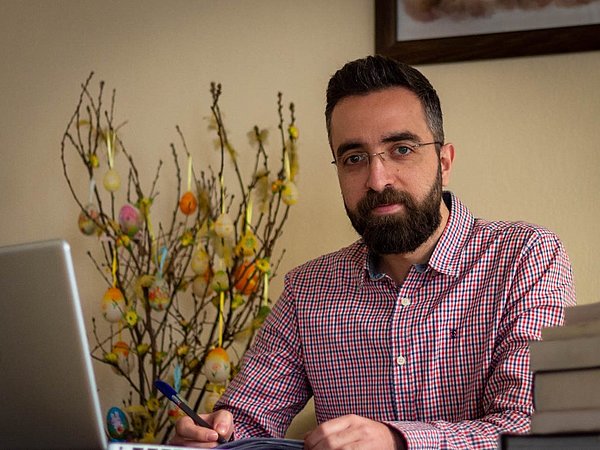
Rimon Wehbi is from Maalula, a Christian village in Syria and one of the last places in the world where Western Aramaic is still spoken—the language that was once the “lingua franca” of the Middle East and in which Jesus also preached. During his childhood, his grandfather often told him and his siblings stories in Aramaic, which Rimon Wehbi recorded on a cassette recorder. “As a child, I just wanted to preserve the stories so I could listen to them over and over again.” As an adult, he became increasingly aware of the uniqueness of the Aramaic language—and the danger that it might die out as a living language.
In 2013, Maaloula became the scene of a conflict between rival factions, which led to significant destruction. As a result, most of the villagers fled. Although the military situation later stabilized, many residents were unable to return to Maaloula. The displacement and dispersal of the Aramaic-speaking community across various countries posed significant challenges to the language’s survival. Experts estimate that a language often survives for only two generations in diaspora communities.
In light of this situation, Rimon Wehbi sought opportunities to begin studying Semitic Studies. To this end, he met with Prof. Dr. Werner Arnold, one of the leading experts on Aramaic, while the latter was on a research visit in Beirut. On his advice, Rimon Wehbi applied for a KAAD scholarship to pursue a master’s degree in Semitic Studies at the University of Heidelberg: “I already had a bachelor’s degree in economics from the University of Damascus, but at first I lacked many of the fundamental linguistic skills required for a master’s program in Semitic Studies. With the support of the faculty, however, I was able to acquire them quickly.” Rimon Wehbi’s story is marked by a thirst for knowledge and a desire to engage academically with his own native language, on which there is also a wealth of German-language literature. With the German language skills he acquired, he was now able to engage with this literature. In early 2018, he completed his degree in Semitic Studies with a thesis on “The Aramaic Water Mills in Maalula,” earning a grade of “very good” (1.3), and returned to Syria shortly thereafter—despite the adverse living conditions.
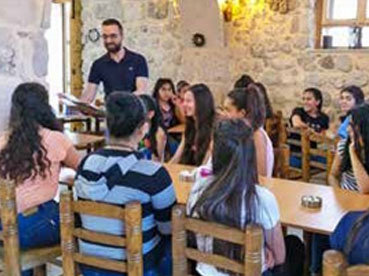
“There are currently perhaps 1,000 people living in Maalula. The churches and monasteries were the first buildings to be rebuilt, but many houses remain in ruins, with no one to take care of them,” he says, describing the current situation. Soon after his return, Rimon Wehbi began volunteering to teach Aramaic to the children of Maalula and to develop his own curriculum. At St. George’s Church, he currently teaches several classes of twenty to fifty students. He also develops his own teaching materials specifically for this purpose, since Western Aramaic is not a written language, and there are virtually no textbooks, especially not for teaching children. Furthermore, he is dedicated to further linguistic research on Aramaic: “I still keep the cassettes with the stories my grandfather told us in Aramaic, but today I also use them for linguistic analysis.”
In addition to teaching, he runs the nonprofit educational project yawna.org—which means “dove” in Aramaic—aimed at preserving the Aramaic language as well as the culture and heritage of Maalula. The site introduces the village and its history and summarizes the current state of historical and linguistic research on Western Aramaic in a way that is accessible to everyone. Rimon Wehbi supported himself by working at an optical shop in Damascus, which he runs with his father and brother, so that he could work on his Aramaic projects in the evenings and travel to Maalula on weekends to teach.
Since September 2023, with support from KAAD, Rimon Wehbi has been pursuing his academic qualifications through a doctoral project in which he is learning modern linguistic methods for preserving and researching ancient languages and applying them to Western Aramaic.


