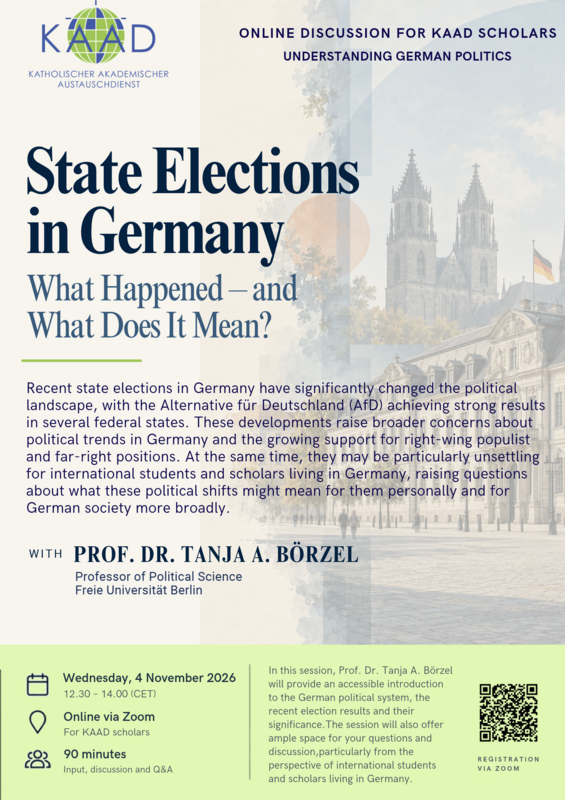
The results of the most recent state elections in Germany are also causing concern among international students who live, study, and conduct research here. For our grant recipients, this raises both personal and academic questions: about their safety and sense of belonging in society, about the future of their fields of research, and about opportunities to advocate for their interests during their stay. KAAD therefore hosted a webinar on November 4, 2026, titled “State Elections in Germany: What Happened—and What Does It Mean?” featuring Prof. Dr. Tanja A. Börzel.
Tanja A. Börzel is a professor of political science and holds the Chair of European Integration at the Otto Suhr Institute of Freie Universität Berlin. As spokesperson for the Cluster of Excellence “SCRIPTS – Contestations of the Liberal Script,” she conducts research on the challenges facing liberal political and social orders. She is affiliated with KAAD as a member of the Academic Committee and as a faculty advisor in Berlin. In her presentation, she explained the political developments and their potential consequences for international students. The webinar was moderated by Nils Fischer, Head of the Middle East Division.
A significant portion of her presentation focused on the distinction between political rhetoric, actual decisions, and existing safeguards. Tanja Börzel explained that Germany’s constitutional order and federal structure limit political interference in democratic institutions. However, she noted that these safeguards depend on political and social actors actively defending democratic rights and challenging exclusionary positions. It is therefore also crucial which ideas are increasingly accepted in public discourse.
For the scholars, this distinction has a direct impact on their lives in Germany. Even though Tanja Börzel emphasized the legal protection afforded to them during their studies, an anti-immigration climate can affect their daily lives and their sense of being welcome. Those who experience rejection based on their appearance, name, accent, or religion are not judged according to the purpose of their stay or their nationality. A secure legal status alone, therefore, does not answer the question of personal safety and social belonging.
Concerns about their own academic work became evident in the ensuing discussion. The scholars and alumni asked whether their fields of research might lose support under a more right-wing political climate. One scholar also described how political developments and their portrayal on social media were causing him psychological distress. In her response, Tanja Börzel distinguished between direct government intervention and restrictions that might arise within universities. Research and teaching are protected by the constitution; the institutional autonomy of universities also limits political influence. However, she saw a particular danger in preemptive obedience: if institutions or faculty members avoid certain topics out of concern for possible political reactions, they would be curtailing their own academic freedom. Under budget constraints, the expectation of future resistance could also influence decisions about which professorships or degree programs would be discontinued. Tanja Börzel countered this by calling for a collective defense of scholarly work. Affected departments should not be left to deal with such developments on their own. Researchers and universities should publicly call out restrictions and support one another.
The grant recipients were also concerned with historical experiences of the failure of institutional safeguards: How reliable are today’s guarantees? Tanja Börzel distinguished today’s German democracy from the Weimar Republic and pointed to the protection of academic freedom that has developed in West Germany since World War II. However, she noted, this does not mean that political pressure is impossible. Even under a stable constitutional order, universities must assert their independence.
For Tanja Börzel, the protection of academic freedom also includes social support: Universities depend on finding support outside the academic community when their independence is under attack. At the same time, they must address their own problems—such as abuse of power and internal conflicts—within the framework of their self-governance.
In addition to potential restrictions, she also described the positive experiences students have had so far with life and research in Germany. Tanja Börzel emphasized the importance of international students for universities. Their knowledge and diverse academic experiences are vital for research and teaching. Inviting international students also entails the responsibility to guarantee them safety, respect, and participation.
An important question raised by the grant recipients concerned political representation during a temporary stay. Who represents the interests of people who live here temporarily and do not have the right to vote in Germany? Tanja Börzel cited university committees, citizens’ initiatives, and open party meetings as opportunities to voice their own concerns. She also encouraged the scholars not to keep their concerns to themselves but to reach out to their universities’ counseling centers, international offices, and the KAAD.
KAAD Secretary General Dr. Nora Kalbarczyk described the webinar as one of several steps the KAAD is taking to respond to political developments and to involve its scholarship recipients in the discussion of these issues.