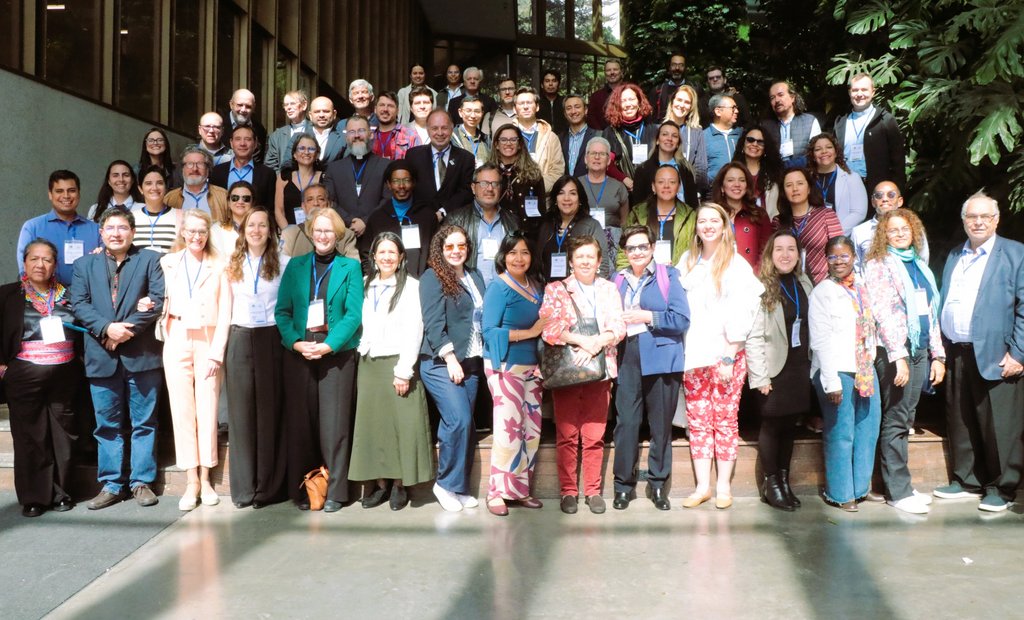
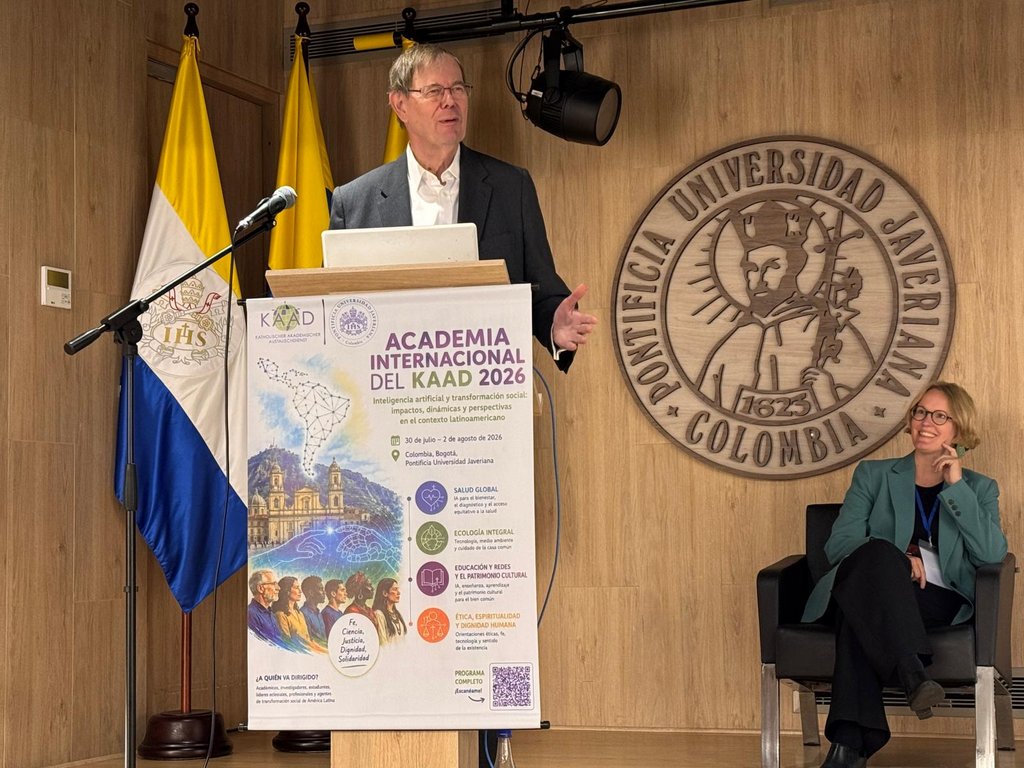
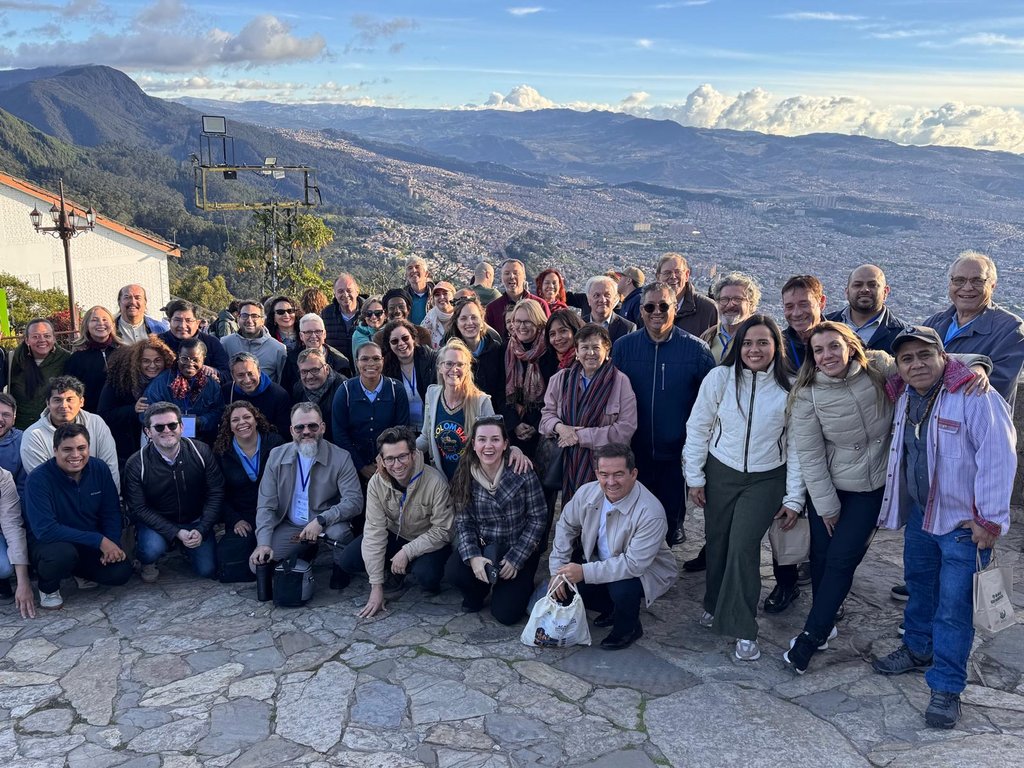
From July 30 to August 2, 83 KAAD alumni from eleven Latin American countries, recipients of the Adveniat-KAAD scholarship program, as well as guests from the Church and academia, gathered in Bogotá to explore what contribution Latin America can make to the global AI debate and how new technological dependencies can be avoided.
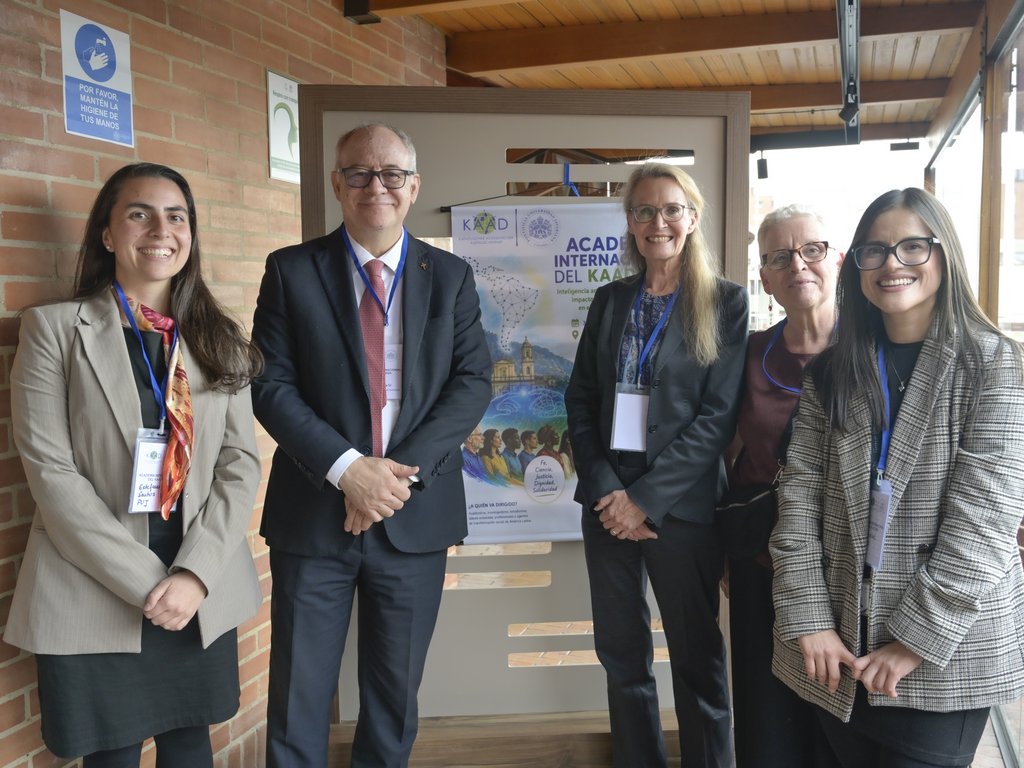
The opening ceremony linked the Academy’s thematic focus with the work of the international KAAD network. The rector of the Pontifical Javeriana University (Pontificia Universidad Javeriana, PUJ), Fr Dr Luis Fernando Múnera Congote, S.J., praised the long-standing collaboration with KAAD; KAAD President Fr Dr Hans Langendörfer, S.J., emphasized the shared responsibility of the international KAAD community. Msgr. Lizardo Estrada Herrera OSA, Secretary General of the Latin American Episcopal Council (Consejo Episcopal Latinoamericano, CELAM), emphasized in a video message to the participants the importance of academically qualified multipliers for the Church and society in Latin America.
KAAD’s network, which has grown over decades, served as an important point of reference for the academy. The eight KAAD partner organizations play a central role in this network; the Latin America Department presented them as the cornerstones of its funding and networking efforts. For KAAD, the members of the partner bodies are not merely alumnae and alumni or representatives, but the “heart of KAAD” in their respective countries.
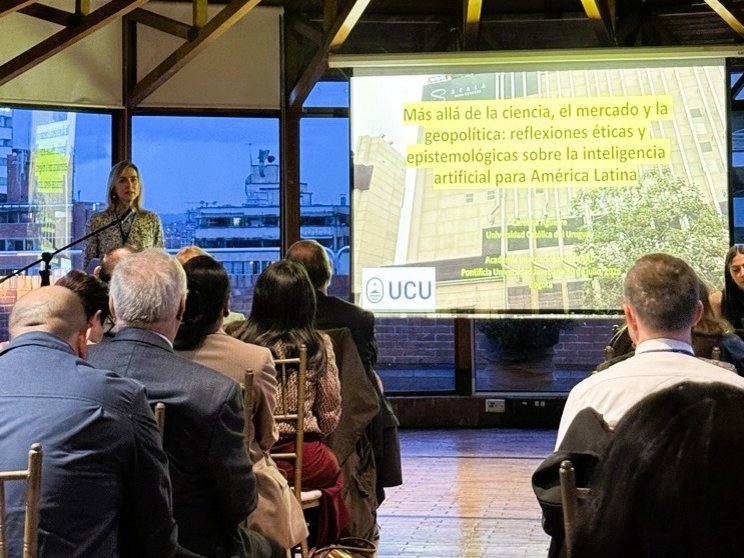
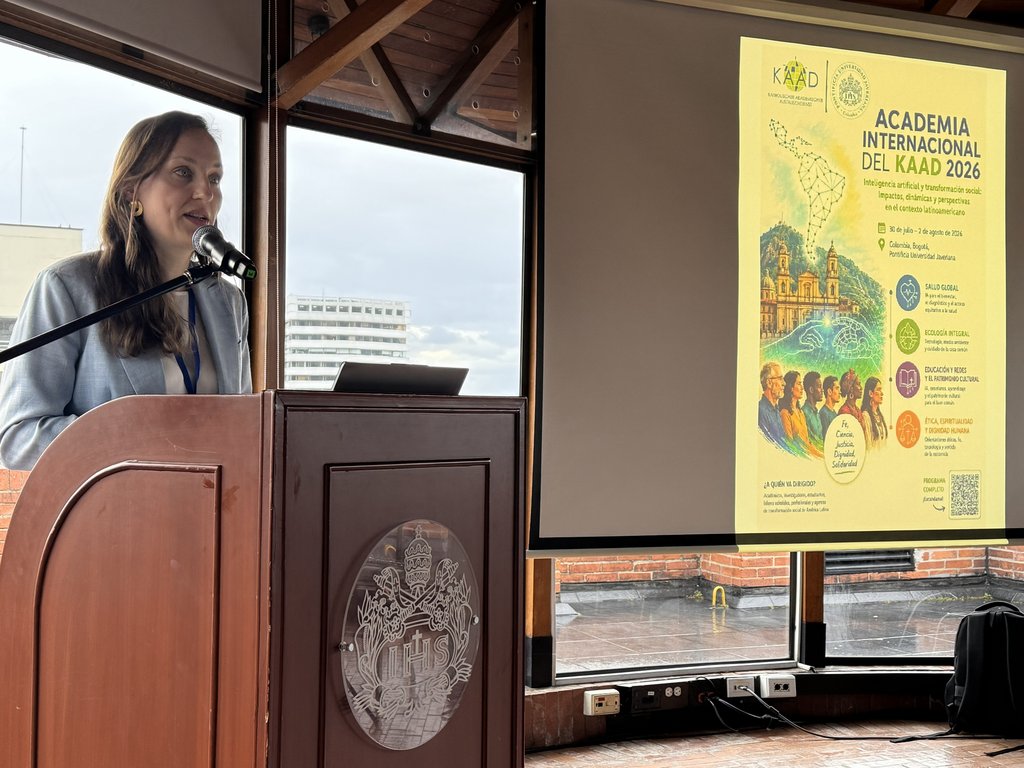
Professor Carolina Aguerre from the Catholic University of Uruguay kicked off the Academy’s thematic program. In her presentation titled “Beyond Science, the Market, and Geopolitics,” she addressed the ethical and epistemological aspects of artificial intelligence from a Latin American perspective. She highlighted how AI can exacerbate global inequalities and shift power in favor of large technology corporations. Furthermore, if marginalized communities are excluded from the development of AI systems, local contexts, experiences, and bodies of knowledge remain insufficiently taken into account.
Dr. Mirjam Rossa, head of the Latin America Division at KAAD, summarized an overarching question of the academy as follows: “With this academy, we didn’t just want to ask what artificial intelligence does to Latin America. The reverse perspective is also crucial: What can Latin America contribute to the global debate on AI with its own body of knowledge, social experiences, and ethical perspectives?”
At a festive reception following the opening ceremony, representatives from international organizations, the Church, and academia gathered.
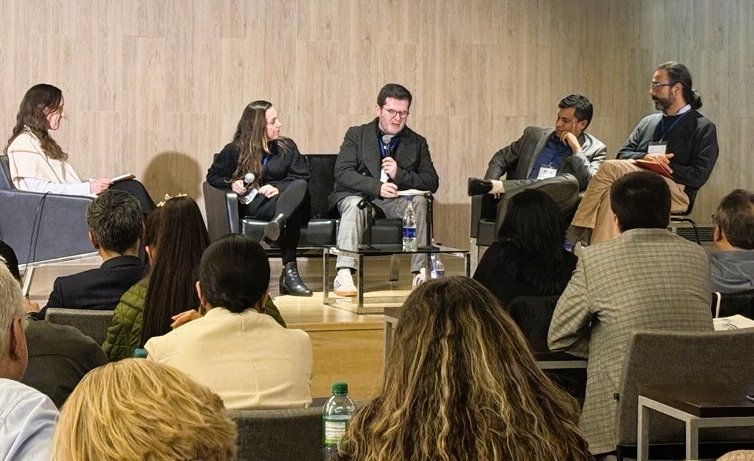
The second day of the academy began with a spiritual reflection by Fr Luis Ferney López. Professor Alexander Caicedo Dorado of the PUJ then provided an introduction to the history, functioning, and current scope of artificial intelligence. Building on this, four interdisciplinary panels examined the impacts of AI on global health, integral ecology, education and academic networks, as well as ethics and spirituality. In the process, a question that cut across all panels increasingly took center stage: How can Latin America not only adopt technological developments and respond to their consequences, but also critically shape them based on its own experiences, body of knowledge, and values?
In the panel on global health, Dr Alberto Méndez, Professor Guillermo Kerz, and Professor Fabiana Faleiros – moderated by Dr. Rosa Helena Bustos – discussed the potential of artificial intelligence for medicine and healthcare. Using concrete examples, they demonstrated AI’s potential for analyzing complex data and streamlining work processes. At the same time, this raised the broader question of what social conditions are necessary for technological innovation to actually contribute to better and more equitable health care.
The panel on Integral Ecology highlighted just how closely technological innovation is linked to global issues of distribution. Juan Fernando Larco, Dr Angelica Muskus, and Dr Katia Cilene Madruga Rodrigues discussed potential applications of AI in areas such as energy supply and agriculture, while also addressing its ecological costs. The enormous energy and water consumption of digital infrastructures, as well as the demand for rare earth elements and other minerals, drew attention to new dependencies and global asymmetries: While technological hubs are often located elsewhere, the ecological and social consequences of raw material extraction disproportionately affect countries in the Global South.
The panel on Education and Academic Networks, moderated by Dr José Luis Luna Bravo, focused on Latin America’s potential for shaping the future. Waira Nina Jacanamijoy Mutumbajoy and Dr Clément Roux presented “Iakumama 2050,” a project that combines digital technologies with indigenous knowledge and, in collaboration with indigenous communities, develops future scenarios for the coexistence of humans and nature in the Colombian Amazon region. Felipe Mejia-Medina and Dr Leonor González expanded the discussion to address the question of what skills people need not only to apply AI but also to help shape its development in a critical, inclusive, and socially responsible manner.
The fourth panel focused on ethical and spiritual perspectives. Moderated by Dr Carlos Miguel Gómez, Professor Fr Dr Peter Lah, S.J., Fr Robson Caixeta Silva, and Dr Marlene Pinheiro Gonçalves discussed the limitations of technical systems and the indispensability of human responsibility. The discussion centered on the question of what distinguishes humans from AI, which appears to be becoming ever more powerful: conscience, the capacity for responsibility, and the ability to evaluate decisions not only based on efficiency but also on their meaning and their consequences for others. This led to the fundamental question of which decisions humans can delegate to technical systems and where responsibility must, under no circumstances, be relinquished.
In the concluding plenary session, these perspectives were interwoven. Across the fields of health, ecology, education, and ethics, common questions regarding power, participation, knowledge, and responsibility emerged. In this context, Latin America emerged not merely as a region affected by the consequences of technology developed elsewhere, but as an actor with its own scientific, cultural, and social experiences, capable of making an independent contribution to the global debate on artificial intelligence. The following morning, these discussions continued with a focus on the future of the thematic working groups and the Latin American KAAD network.
On Saturday, participants discussed concrete prospects for the thematic expert groups as venues for transnational academic exchange in interactive workshops and agreed on next steps, including joint publications and events as well as new forms of interdisciplinary and transnational cooperation. In the subsequent plenary reflection, “Common Horizons, Shared Challenges,” the focus was therefore no longer merely on the question of what AI means for Latin America, but also on what Latin America itself can contribute to the global debate on AI: its own body of knowledge, experiences with social inequality, alternative conceptions of community and development, as well as social, cultural, and spiritual perspectives. At the same time, the danger of new technological and economic dependencies was critically discussed. In addition to analyzing current transformation processes, concrete next steps for the KAAD network’s future work were also outlined.
In her closing remarks, KAAD Secretary General Dr Nora Kalbarczyk noted that by engaging with the development of artificial intelligence and its consequences for people and society, the participants had embarked on the path of reflection to which Pope Leo XIV invited us to take in his encyclical “Magnifica humanitas.” In doing so, she revisited a central question for the Academy: How can we prevent artificial intelligence from exacerbating existing inequalities and injustices, and how can it be harnessed to serve holistic and just human development? She described the search for answers to this question as a core concern of the KAAD and its community.
Fr Dr Hans Langendörfer, S.J., then thanked the many people who had contributed to the success of the International Academy with “extraordinary dedication” – from the initial conceptual considerations through careful preparation to the actual implementation on site.
In addition to the lectures and discussions, a guided tour of the campus gave the participants the opportunity to get to know the Pontifical Javeriana University, the Academy’s host, more closely. A cultural program and a Mass celebrated by Fr Langendörfer, S.J., and Fr Luis Ferney López at the pilgrimage church Basílica del Señor Caído de Monserrate concluded the days spent together in Bogotá.
The International Academy was not only a venue for scholarly engagement with artificial intelligence; it also demonstrated a structural strength of the KAAD: its network, which has grown across countries, disciplines, and generations, makes it possible to discuss global issues of the future from the perspective of diverse regional experiences and to bring these perspectives into international academic and societal discourses.
The Pontifical Javeriana University also highlighted the International Academy in a separate article:
[“La Javeriana fortalece su relacionamiento con el KAAD”].